
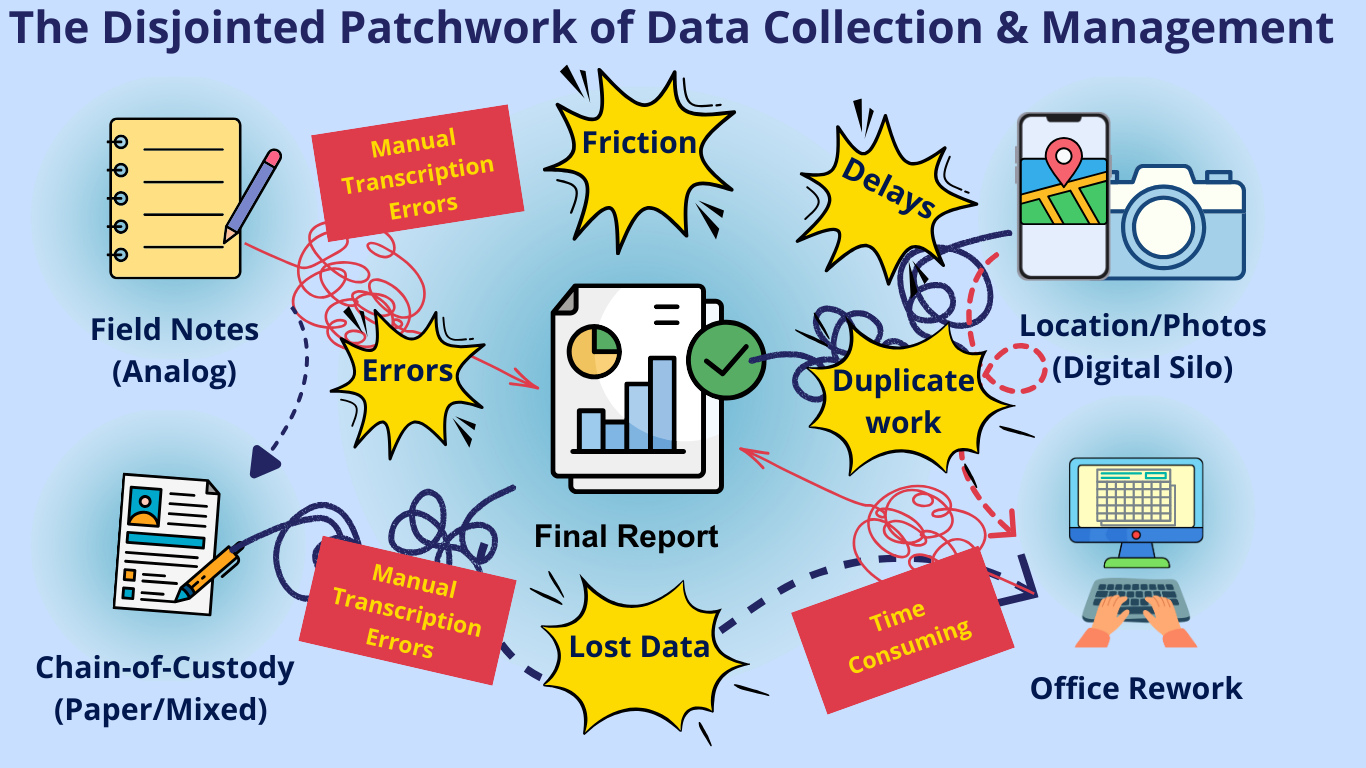
For environmental consultants and hazardous material professionals, the quality of the data collected in the field is one of the most important building blocks of success. Every major decision—from remediation plans and compliance reports to risk assessments—stands or falls on the accuracy of field data like soil samples, asbestos inspections, and Chain-of-Custody (COC) documentation. This data forms the "invisible infrastructure" that supports every strategic recommendation a firm makes.
Yet, despite the high-stakes nature of this work, the actual process of collecting and managing this foundational information often remains trapped in the past. If you consider your whole journey of data, from Collection in the field, to Management in the office, and finally the Use of data (such as generating the final report), does the image above resonate with you?
The "Quiet Crisis" in Data Management
Through extensive primary market research, including in-depth interviews with more than 300 environmental and hazardous material consulting professionals across North America, we uncovered a systemic issue. The collective message is clear: the current reality of field data collection and management is a frustrating blend of manual data entry and fragmented digital tools.
Far too often, the field data process is built on a disjointed patchwork of pen & paper, field notebooks, standalone GPS units, and manual entry into databases back at the office.
This reliance on manual, disjointed data collection is more than just an inefficiency—it is a "quiet crisis". It introduces unnecessary risk into critical projects, drags down profitability, and diverts valuable resources away from high-level analysis back to administration tasks.
The Human Cost of Manual Entry
The most significant drain on an organization is often the misuse of its best talent. Manual data entry processes act as the primary bottleneck to an organization’s productivity.
Instead of focusing on strategy, highly qualified personnel are forced to spend hours in the office just entering and organizing data. As one environmental professional stated during our research:
“No one has gone to school to be a data entry person, and yet they need to spend a huge amount of their time doing data entry and rechecking to make sure data is entered correctly, instead of spending their time on what matters using their skillset”.
The industry recognizes the problem. Kyle Schlafer, Operations Manager at Integrity Environmental Testing, expressed critically that firms want to automate field data collection and have that information auto-populate into reports to "save significant time as well as reduce errors".
Moving Forward
If the frustrations of manual re-work, disjointed apps, and late nights spent transcribing notes resonate with your experience, you are not alone. The industry is facing a data dilemma, and the need to move from manual field data collection and management practices to automated intelligence is urgent. What we heard often in interviewing industry professionals aligns with this desire:
We would like to make our operations more efficient by allocating staff time to more critical tasks if:
In the field, they did not have to use pen & paper or a variety of disjointed tools to collect all necessary data (sample information, pictures, sketches, etc.).
In the office, they did not have to manually transcribe all that field data into our database.
When it comes to reporting, they did not have to stitch all that data together.
In this five-part series, we will pull back the curtain on these challenges using unfiltered insights from industry leaders to expose the real cost of the status quo.
Next Article: We will dive deeper into the specific mechanics of the "Time & Talent Drag," exploring exactly how the field-to-office bottleneck drains billable hours.