
In our previous post, we looked at the Juggler’s Dilemma and how chaotic field collection sets a project off on the wrong foot. But even with a great field team, many firms hit a brick wall the moment those technicians step back into the office.
Welcome to Stage 2: The Transcription Trap. This is the "messy middle" of the project lifecycle where billable hours go towards rudimentary data management tasks and human error finds a permanent home in your reports.
The Anatomy of a Trap
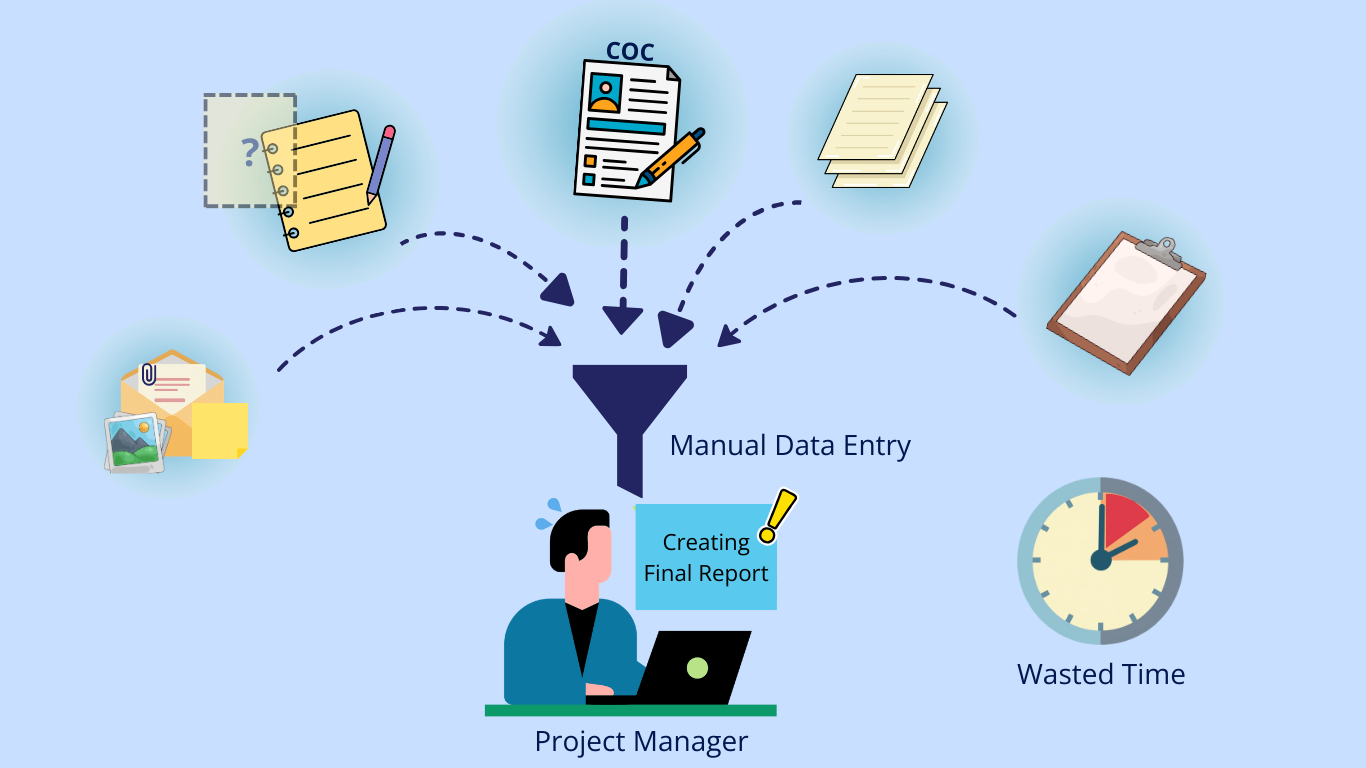
When a Project Manager (PM) sits down to start a report, they aren't usually analyzing data—they are translating it. They are surrounded by:
● Handwritten Site Logs: Often smudged, damp, or illegible.
● Disconnected Photo Folders: Thousands of images that need to be manually matched to sample IDs.
● Lab COCs: Paper forms that must be cross-referenced against field notes to ensure no samples were missed.
● Lab Reports: Normally emailed as a pdf file, in need of cross-referencing with field data and then manually inserted into the reports
The True Cost: The "High-Paid Clerk"
The Project Manager is one of the most valuable assets in an environmental firm. You pay them for their expertise, their client management skills, and their ability to navigate complex regulations.
However, in a manual workflow, you are effectively paying a senior professional salary for data entry.
● Wasted Billable Capacity: Every hour a PM spends manually sorting and inserting data is an hour they aren't running new projects or managing clients.
● The "Funnel" Bottleneck: Because manual entry takes so long, the PM becomes a bottleneck. Even if the field crew is fast, the reports can only move as fast as the PM can type. This leads to the "Report Backlog" that keeps your firm from scaling.
The Human Error Factor: "The Game of Telephone"
Transcription isn't just slow; it’s dangerous. When data is moved from a field notebook to an Excel sheet, and then from Excel to a Word document, the "integrity" of that data degrades with every touchpoint.
● A "5" becomes an "S".
● A decimal point moves one place to the left.
● A sample description for "Room 101" accidentally gets pasted into "Room 102".
In the world of Hazmat and Environmental compliance, these aren't just typos—they are legal liabilities.

How to Break out of the Trap: The Digital Hand-off
Breaking the Transcription Trap requires a fundamental shift: Stop entering data manually and start managing it.
Direct-to-Database Sync: When a field tech enters data into an integrated system, it should populate the PM's dashboard instantly. No re-typing required.
Instant Communication: PM can monitor data as it is being collected in the field, correcting course of action if necessary.
Automated Photo Linking: Use tools that automatically timestamp and geo-tag photos to the specific sample entry, eliminating the "photo sorting" nightmare.
One-Click Reporting: Instead of copy-pasting tables, use templates that pull data directly from the field inputs and lab reports into the final report layout.
The Result: Faster Reports, Higher Margins
When you eliminate the "Transcription Trap," you don't just get reports out faster; you reclaim the soul of your firm. Your PMs are happier because they are doing the work they were trained for, and your COO is happier because the project profit margins aren't being eaten away by unbillable office hours.
Coming up next: We look at the "Final Defense"—Stage 3: The Quality Gate, where we see how manual errors turn into a QA/QC manager's worst nightmare.