
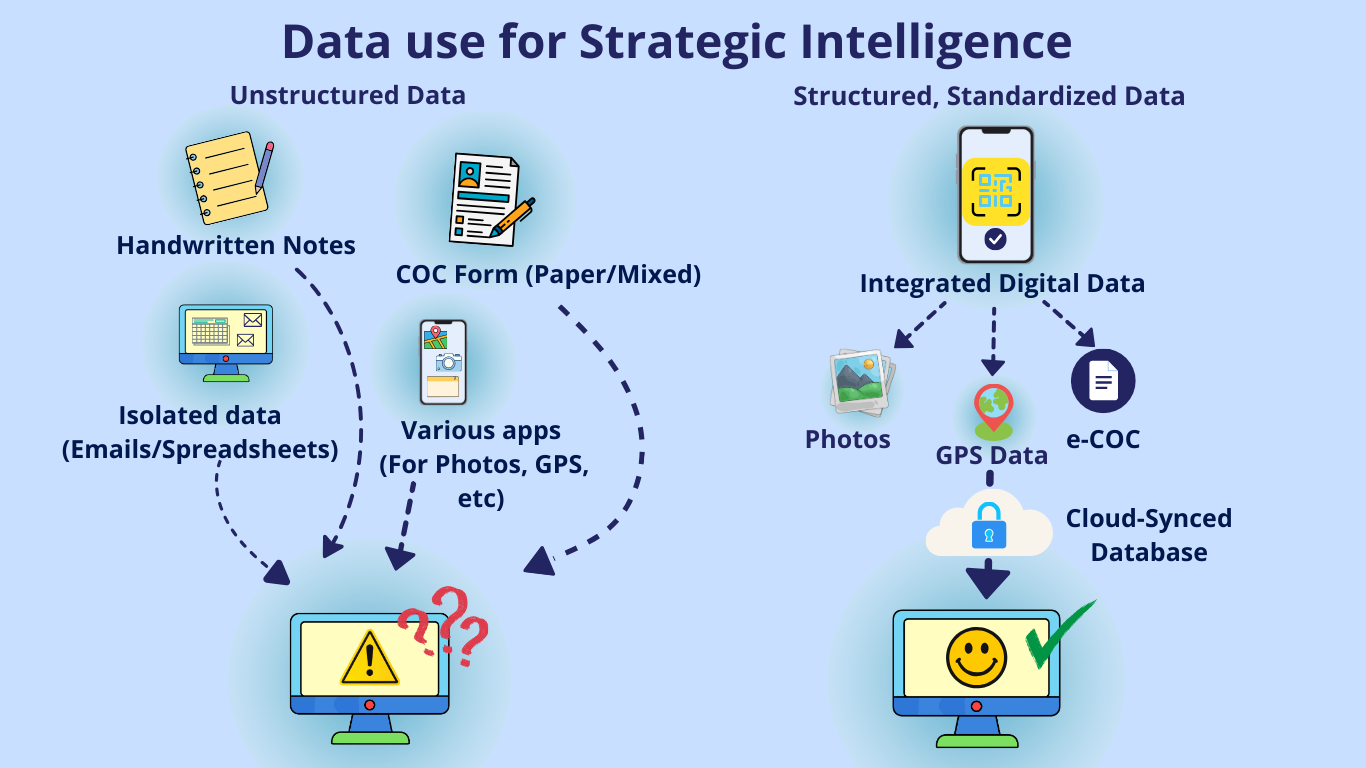
The environmental consulting industry is rapidly approaching a technological crossroads. We are entering an era where predictive analytics and AI/ML will become standard tools for complex site assessments, advanced forecasting, and risk modeling. Even on a more daily basis, the industry is recognizing that their staff time and resources must be allocated to more critical tasks, rather than spending hours on stitching data together from different sources to prepare the final report. This is where data silos created inadvertently from disjointed manual field data collection and management practices become the biggest bottleneck for the industry.
Our research with over 350 industry professionals reveals a hidden obstacle: the data most firms collect today is fundamentally unprepared for this future.
The Barrier of Unstructured Data
The administrative burden of manual transcription is only the tip of the iceberg. The deeper, more strategic cost of current field data workflows is the creation of disjointed, unstructured data silos.
When your project information is scattered across:
● Handwritten field notebooks
● Isolated spreadsheets and emails
● Separate GPS units or specialized apps
● Paper Chain-of-Custody (COC) forms
...it becomes impossible to leverage that data for efficient use of data advanced analysis. AI and ML tools require clean, structured, and standardized datasets to operate effectively. Fragmented data that lacks consistent metadata and a reliable audit trail is, by definition, not AI-ready.
Why "Standardization" is the New Strategy
Firms that focus only on fixing their immediate field data collection problems using a group of disjointed “readily available” tools are missing a massive strategic opportunity. By staying trapped in the cycle of manual or mixed-digital data collection, they are inadvertently building a long-term barrier to using advanced analytical tools.
To tap into the power of data-based decision-making, information must be gathered in a clean, standardized format from the very beginning. This means moving away from "stitching" data together as a pre-report chore and moving toward a system where every piece of sample metadata—time, location, and observations—is captured in an integrated, digital environment.
From "Data Entry" to "Strategic Intelligence"
The goal isn't just to work faster; it’s to work smarter. When your data is structured and standardized, it becomes a permanent asset rather than a temporary file in a folder. This shift moves the focus from the administrative burden of today to the strategic environmental intelligence of tomorrow.
Next week in our post: We present the solution. We explore how automation and platforms like aQRate™ are helping firms achieve 60% more efficiency and a 33% reduction in errors.